When you're investing in pollination services for your operation, hive size matters more than you might think. Understanding the difference between 6-frame and 10-frame colonies can help you make informed decisions that directly impact your crop yields.
A 10-frame bee colony is a far more effective superorganism and pollinator than its smaller counterpart. These colonies are significantly more efficient because the ratio of "house bees" (nurses) to "field bees" (foragers) shifts in ways that benefit your crops.
Because the "overhead" of keeping the hive warm is already met and the brood care and house activities have an adequate number of participants, a 10-frame hive can send out twice as many foragers as a 6-frame hive, despite having only 66% more total bees. Even more impressive: bees from stronger colonies begin foraging 45 minutes earlier each day.
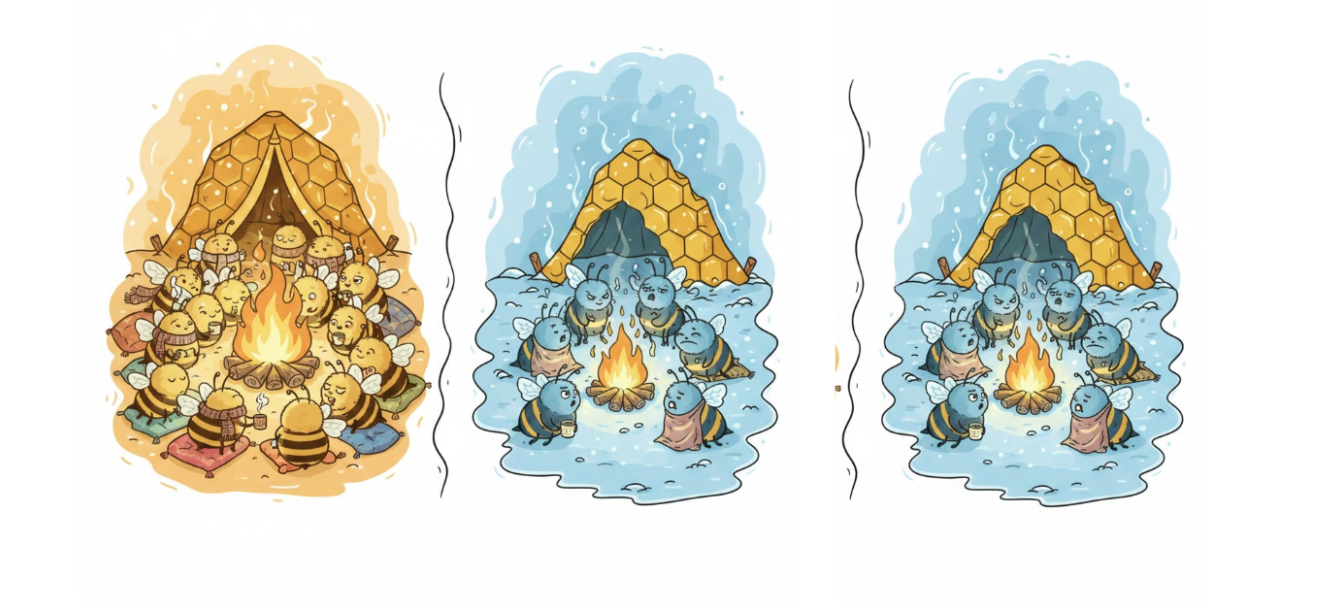
Just as two small fires emit less heat than one large fire, one large hive is able to thermoregulate the brood and send a far larger foraging force into your fields.
That efficiency translates directly to pollination performance:
More boots on the ground: With double the foragers per unit of bees, 10-frame hives deliver more flower visits per acre. This means better coverage across your field and more complete pollination, especially important for crops like almonds, apples, and blueberries where thorough pollination directly correlates with fruit size and quality.
Extended working hours: That 45-minute head start each morning adds up. Over a 3-week bloom period, you're gaining approximately 22.5 additional foraging hours per hive. For crops with narrow pollination windows or weather-dependent blooms, this early activity can make the difference between adequate and exceptional fruit set.
Better weather resilience: Stronger colonies are more likely to fly in marginal conditions—cool mornings, light winds, or partly cloudy days when pollination is still possible but smaller colonies keep their foragers home.
Not all hives are created equal. A box sitting in your orchard might contain anywhere from 4 to 10 frames of bees, and that difference is enormous when it comes to pollination outcomes. This is why BeeHero uses frame-based pricing rather than traditional per-hive pricing. When you pay for frames of bees rather than boxes, you're paying for actual pollination power, not just wooden equipment in your field.
For early-season crops: If your crop blooms early in the season (like almonds), that 45-minute daily advantage becomes even more valuable during short, cool days when every foraging hour counts. Strong colonies start working when it matters most.
For high-value crops: When pollination directly impacts fruit size, quality, and set (as with apples, cherries, blueberries, and almonds) the efficiency of 10-frame colonies means more complete pollination coverage and better economic returns per acre.
Consistency you can count on: Frame-based specifications give you predictable pollination performance. You know exactly what foraging force you're getting, not just how many boxes are present.

Pollination isn't just about having bees present, it's about having enough active foragers working your bloom at the right times. The biology of stronger colonies means they deliver disproportionately more pollination bang for your buck. When evaluating pollination services, look beyond hive count to hive strength. A 10-frame colony isn't just 66% bigger, it's twice as effective at getting the job done.
Planning ahead for next season and looking to improve pollination outcomes? BeeHero is here to help. Connect with our team to explore how precision pollination can maximize crop potential and reduce costs for your operation.
Evans, S.K.; Evans, H.; Meikle, W.G.; Clouston, G. Hive Orientation and Colony Strength Affect Honey Bee Colony Activity during Almond Pollination. Insects 2024, 15, 112.
Farrar, C. L. (1937). The influence of colony populations on honey production. Journal of Agricultural Research, 54(12), 945–954.
Meikle, W. G., Weiss, M., & Beren, E. (2023). Effects of hive entrance orientation on honey bee colony activity. Journal of Apicultural Research, 62(3), 444–449.